
What's Really Behind a Failed Career Change? Hint: It's Not Your Resume.

Woman grabbing her back in pain while sitting on a couch.
I want to tell you about something I'm still experiencing.
A few weeks ago, I gave what might have been one of the best talks of my career — two hundred and fifty HR professionals moved through a room and experienced a collective mindset shift. I left that stage feeling lit up. Proud. Fully alive in my purpose.
The very next day, I couldn't move.
I threw out my hip so badly I could barely walk to the kitchen for a glass of water. I was holding onto walls, breathing through the pain, barely sleeping. I drove 1.5 hours to my first physical therapy appointment on extra pain meds — and the moment I walked into my PT's office, I burst into tears. I have never cried from pain in my life. Not from a sprained ankle rock climbing, not from falling off the balance beam as a kid, not from hitting rocky earth on a trail run. Never. Until now.
Four weeks later, I'm still not back to baseline. And somewhere between the heat packs and PT appointments, I started asking a question I wasn't expecting:
Why did my body do this the day after the biggest win of my year?
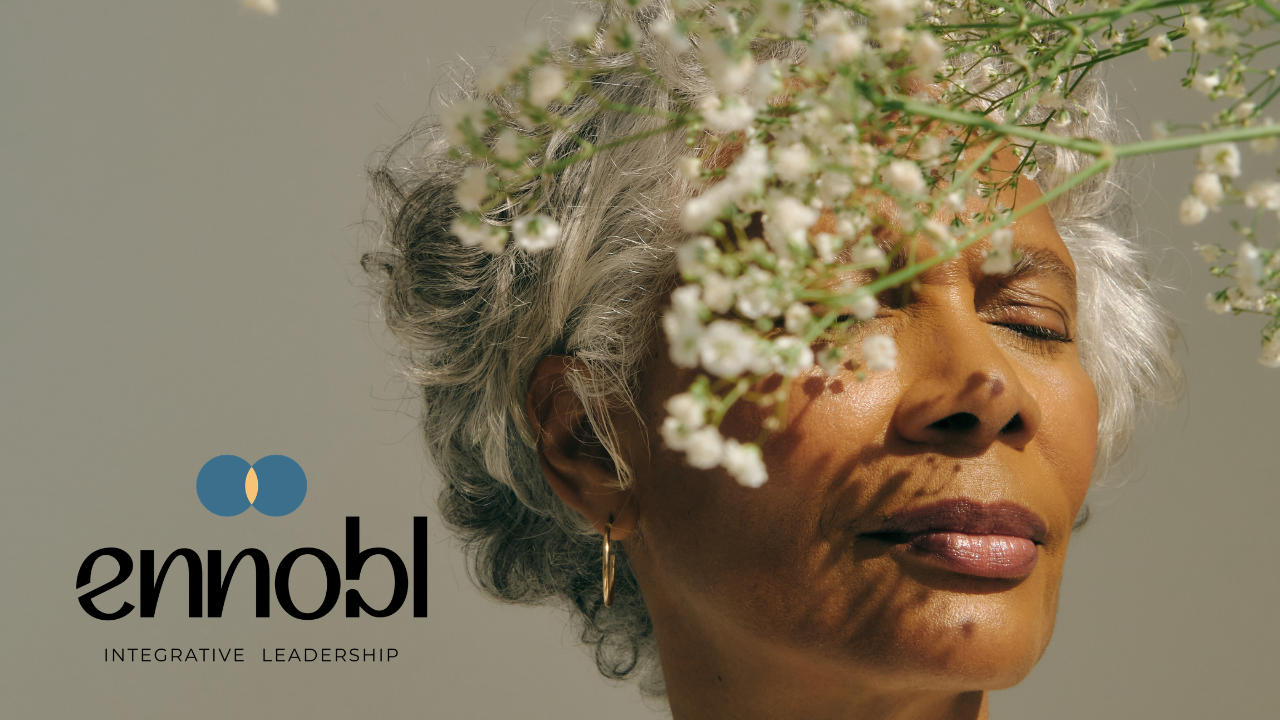
Woman with serene expression standing behind flowers.
The Body Keeps the Score, Even When the Mind Doesn't
My physical therapist offered me a perspective I haven't been able to shake. Women, she said, are the shock absorbers of society. We manage other people's emotions, diffuse tension, smooth over conflict, and hold space for everyone around us — at work, at home, in our communities — so automatically and constantly that we often don't even notice we're doing it.
And all of that absorbed stress? It lives somewhere. It doesn't dissolve. It settles into muscles, joints, and nervous systems — and waits.
The research backs this up. Studies consistently show that women are more likely than men to report physical symptoms of stress and burnout. More than half of women — 53% — report experiencing more stress than the previous year, and nearly half report workplace burnout. A meta-analysis confirmed that women are more likely than men to experience symptoms of both physical and emotional exhaustion from work. We are not imagining it. It is real, it is documented, and it is showing up in our bodies.
For me, the pattern that surfaced was this: being visible is dangerous. Standing on that stage — fully seen, fully exposed, fully myself — triggered something ancient and deep. And my body, loyal as ever, tried to protect me the only way it knew how.

Multiple generations of women in one family smiling.
It May Not Even Be Yours to Begin With
When I started tracing this pattern back, I looked at the women in my family and where they came from — Eastern Europe, generations of people who survived invasion, occupation, and hardship. For them, being visible was dangerous. Staying small, staying quiet, staying invisible — that was survival.
My grandmother lost her father in the Spanish Flu of 1918. A year later, her mother remarried out of necessity — a farm to run, children to raise. Stepdad was not the same loving man as Dad. Years later, when my mother experienced traumatic events in her own youth, my grandmother shut her down completely. Act right. Don't make noise. Blend in. What will the community think? Grandma passed on what she knew — what her own mother had lived. Don't be visible. It's too dangerous.
Science is beginning to confirm what many of us have sensed intuitively. There is increasing evidence that traumatic experiences — including threat to life and collective hardship — can be transferred across multiple generations through epigenetic changes in gene expression. Intergenerational trauma refers to effects observed in children of exposed parents; trans-generational trauma describes effects that appear in later generations with no direct exposure to the original event.
In other words: some of what we're carrying was never ours to begin with. It was handed to us — silently, invisibly — by the women who came before us. And it is showing up in our health, our choices, and our capacity to be fully seen in the world.

Woman walking on the street carrying a large basket full of many items, that looks heavy.
What Are You Still Carrying?
If you're a mid-career woman feeling stuck, burned out, or quietly wondering if there's something more — sit with this:
The thing standing between you and the career you actually want is probably not your resume. It's not your skills, your network, or your timing. It's a belief — old, inherited, deeply buried — that says it's not safe to be fully visible. That your dreams are somehow dangerous. That shrinking is survival.
And the corporate world reinforces it. When women are too "assertive," we become difficult, not a team player, too demanding. Unliked women don't get promoted — they get stuck, and they burn out. When we speak up about workload, we become "emotional" and are told we can't handle the role. Meanwhile, a male colleague raising the exact same concern is seen as offering constructive feedback.
The pattern is real. The environment didn't create it — but it sure knows how to activate it.
Here's the hard truth: if you leap into a new role, a new industry, or your own business without examining what's underneath, you'll likely recreate the same dynamics in a new setting. The environment changes. The pattern stays. I've done this myself — more than once — and I don't want you to have to do it too.
A career change is actually one of the most powerful moments to pull these patterns out at the root. It's a natural inflection point — the old way clearly isn't working, the new way hasn't taken shape yet. That uncomfortable in-between space? It's not an obstacle. It's an invitation.
The work isn't just updating your LinkedIn profile. It's asking yourself honestly: What do I believe about being seen? What do I believe I deserve? What am I still carrying that was never mine to begin with?
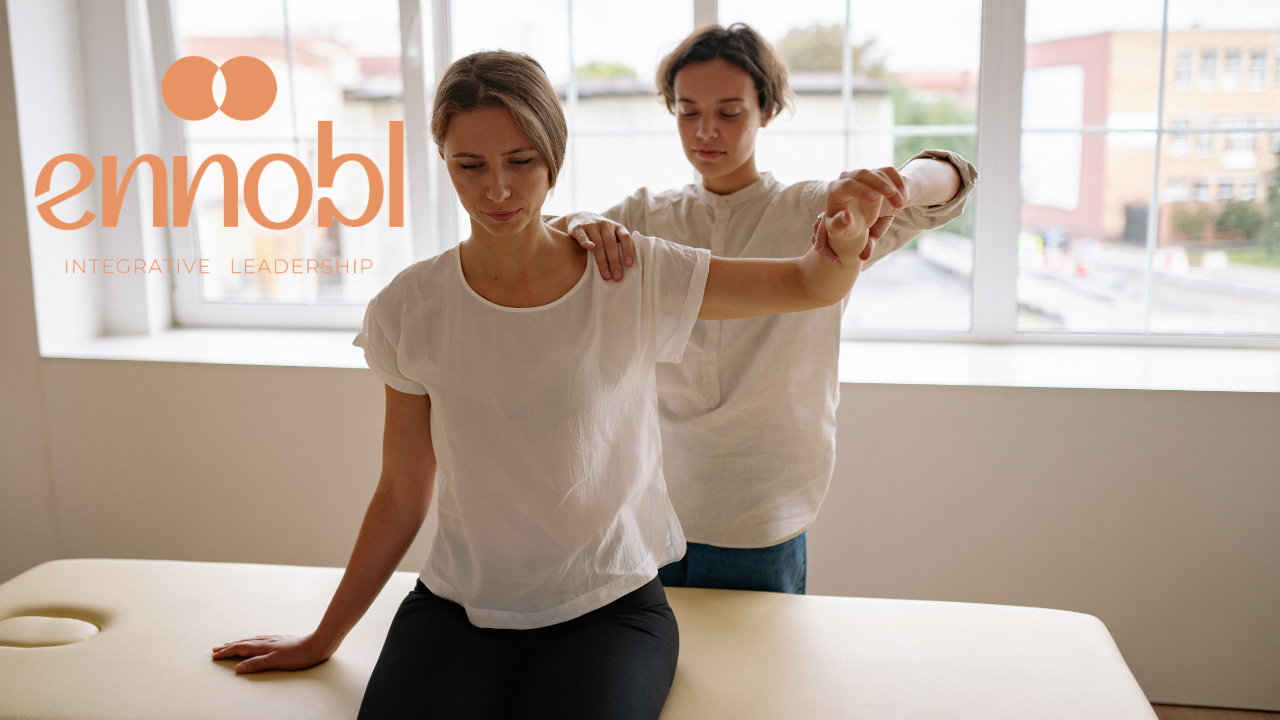
Physical Therapist helping a woman patient with her arm and shoulder.
What You Can Do
I'm not angry about what happened to my body. I'm grateful. I'd rather this come up and out now — painful as it is — than lay dormant until it surfaces harder, later, in ways I can't control.
Here's what has helped me:
Stay curious, not critical. When tension, pain, or fatigue shows up, get curious before you get frustrated. Ask: What might this be telling me? What's happening in my life right now? The body is always communicating. We just have to learn to listen.
Name what you don't want. I have been actively, intentionally telling every part of myself: I don't want this pattern. I don't want this fear. I don't want this pain. It sounds almost too simple. It is also surprisingly powerful.
Let it move through. Somatic practices — gentle movement, breathwork, body-based awareness — help the nervous system process what the mind hasn't been able to. I've been doing about 20 minutes of gentle yoga and foam rolling every morning. By day two, I'd made major progress. Sometimes all our bodies need is a little intentional TLC.
Find your people. Healing in community is faster and deeper than healing alone. Surround yourself with women doing this work alongside you — not perfectly, but honestly. And if a practitioner doesn't celebrate your healing and empowerment, find one who does.
You Were Made for the Room You're Walking Into
Energy is real, and it travels without barriers. Every woman willing to face what's underneath — who chooses curiosity over avoidance, visibility over safety, growth over comfort — makes the world better. Not just for herself, but for every woman who comes after her.
What you put out into the world comes back amplified. Especially in a career transition — so ask yourself: what do you want amplified? Support. Compassion. Accountability. Gentleness. Acknowledgment. Start by offering those things to yourself and to your body. Then open up to receive even more.
I'm still healing. I'm still learning. And I'm more committed than ever to walking into every room I want to be in — especially the ones that scare me.
You don't have to do this alone. Walk in with me.
Learn More on June 1st
If this resonated, I'd love to see you at my next Monday Un-Madness LinkedIn Live on June 1st. We'll talk practical everyday self-care for the workplace — how to survive a season you didn't choose with more grace, patience, and sanity intact. Because taking care of yourself isn't self-indulgence. It's how you make it to the career — and the life — you're actually building toward.
Put it on your calendar: https://www.linkedin.com/events/mondayun-madness06-01-267465568122654187520/theater/
